Algal Blooms and ALS
Investigating Toxic Cyanobacteria and Related Health Impacts
.

A new collaborative study on the Chowan River and Albemarle Sound unites a northeastern NC community and Duke University researchers.
When the summer heat comes rolling in, the people of Edenton turn to the Chowan River for relief. However, since 2015, cyanobacterial harmful algal blooms (cyanoHABs) have become a more regular threat.
In 2025, the North Carolina Department of Environmental Quality (DEQ) received 91 reports of blooms for the northeastern region alone.
Cyanobacteria, also known as blue-green algae, are among the oldest living microorganisms on Earth. Ubiquitous in our waterways, marine and freshwater cyanobacteria generate 20 to 30 percent of our oxygen through photosynthesis.
However, when cyanobacteria overgrow and cause “blooms,” they deplete oxygen as they decompose and choke out other aquatic life.
More than just an environmental issue, cyanoHABs are a threat to public health because many species secrete toxins that can cause serious, immediate health effects — and potential long-term health impacts — for people who live, work, and recreate on the water, as well as for their pets.
Organized in 2007 and established officially in 2012, the Chowan Edenton Environmental Group (CEEG) investigates the causes and effects of cyanoHABs. A coalition of concerned community members collects samples and shares frequent updates on water quality along the Chowan River and Albemarle Sound.
“Our mission is to bring quality science to the area,” says CEEG Chairperson Colleen Karl, “and to work collaboratively with researchers to not only formulate questions, but to join them in trying to find the answers.”

In spring of 2025, with the support of a Community Collaborative Research Grant (CCRG) and a grant from The Duke Endowment, Karl joined forces with Lisa Satterwhite, an associate research professor in Civil & Environmental Engineering at Duke University, and Ashley Stoop, health director of the Albemarle Regional Health Services (ARHS).
Their goal was to gather data to understand the different levels of toxicity from cyanoHABs — as well as to investigate a potential connection between cyanoHABs and the high prevalence of amyotrophic lateral sclerosis (ALS), also known as Lou Gehrig’s disease, in northeastern North Carolina.
CyanoHABs and Lou Gehrig’s Disease
ALS is a rare and incurable neuromotor disease that causes the nerve cells in the upper and lower parts of the body to stop working, according to the Centers for Disease Control and Prevention. As a result, people with Lou Gehrig’s typically experience muscle weakness and eventually paralysis.
Based on North Carolina’s mortality data, the prevalence of ALS is 2 per 100,000 people; according to the ARHS, the prevalence across the nine counties with most of the region’s bloom reports is five times the state average.
Although the majority of ALS cases are of unknown cause, studies show many health, occupational, and environmental factors are linked with higher prevalence of ALS, including exposure to the cyanotoxins “BMAA” and “microcystin.”
BMAA, or β-N-methylamino-L-alanine, was the initial neurotoxin that linked cyanoHABs with ALS.
“BMAA is correlated with ALS in environmental studies, animal models, and even in a military population in Guam,” Satterwhite explains.
“Understanding the causative relationship between an environmental exposure to cyanoHABs and ALS is a 20-to-30-year project,” says Karl, “because people who have been exposed to the blooms now may not show symptoms for that long, and any disease emerges through a complicated interplay between genetics, the environment and stress.”
Until now, Satterwhite, Stoop, and Karl have relied on death certificates to gather insights on patterns of ALS prevalence, but they lacked a comprehensive record of algal blooms.

“The sampling CEEG was doing 10 years ago is nothing like what we are able to do today,” says Karl. Karl says the CEEG team has progressed from a minimal set-up to top-of-the- line equipment by partnering with Satterwhite and Stoop, local universities, the CCRG, and similar programs.
“Our current work is a lot about ALS,” Karl says, “but it’s also about getting the background data that we need to just explain what’s going on in the ecosystem, period.”
In addition to BMAA, the team is investigating microcystin, another common toxin linked to ALS; cyanobacteria also produce microcystin.
Short-term exposure can cause diarrhea, headaches, allergic reactions, and rashes, as well as numbness and even seizures. Long-term chronic exposure to the toxin is also linked with chronic liver disease and neurodegenerative diseases.
The Chowan Chicken Run
The Chowan River and a portion of the Albemarle Sound accessible from Edenton are currently a part of DEQ’s Ambient Water Quality Network, which tests water quality monthly.
While routine monitoring provides important insights into the overall health of the river, algal blooms don’t appear on schedule. Rather, due to limits in personnel and the vastness of area where blooms occur, DEQ relies on reports from the public to track algal blooms and fish kills in between monthly tests.
The CEEG, however, has the capacity to sample and test on a more frequent basis, alerting DEQ about blooms and their severity.
“It takes about five hours to go up one side of the river,” says Karl. “We call it the ‘Chowan Chicken Run,’ because there’s really only one place to stop along the way” — a Duck Thru gas station with a Champs Chicken in Winton.
The station marks the halfway point on the route across the 11 sites that Karl and her volunteers visit.

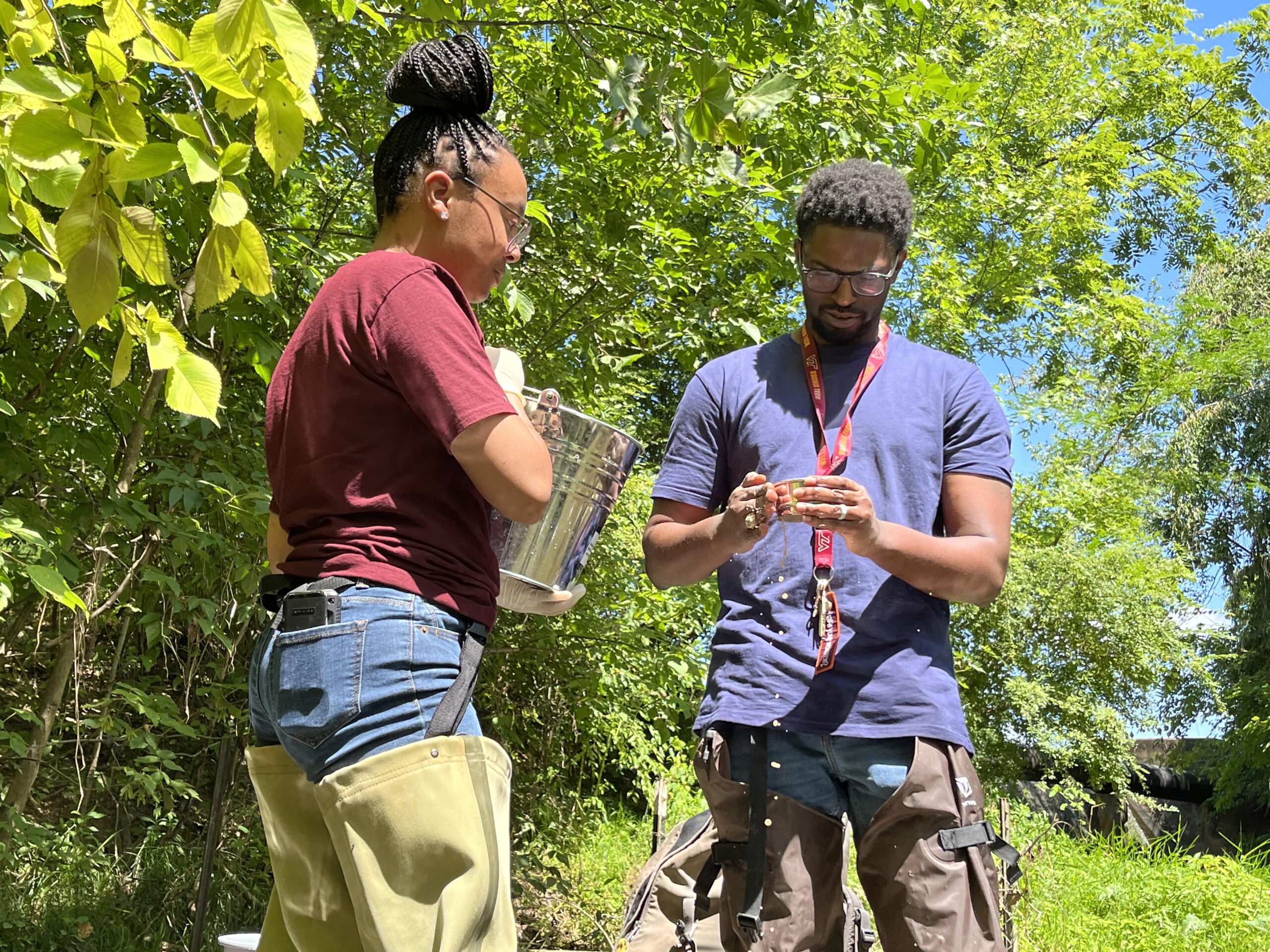
At each site the CEEG team takes five or six samples and tests each for a variety of water quality indicators. Their most powerful piece of equipment, the AquaTROLL, allows them to take live, simultaneous readings of several water quality indicators, including salinity, pH, temperature, and Blue-Green Algae index (an estimate of the concentration of cyanobacteria based on its pigments).
Additionally, Karl has a microscope set up in her car that allows the team to capture images of the cyanobacteria.
Testing for toxins is a bit more complicated. Precise, reliable measurements require a laboratory setting.
However, currently there are no nearby testing facilities available. So, the CEEG is working collaboratively with Satterwhite and the research community to manage the responsibility of capturing and analyzing the samples.
“The day is long, and we hope and pray that the ice machine is working, especially in the summertime,” says Karl. “The samples either have to come back to the freezer for Satterwhite’s toxin analysis at Duke, or they need to at least be kept cool enough to ship to the UNC Institute of Marine Sciences at Morehead for nutrient analysis by 3 p.m. that day.”
Although they’ve reduced the turnaround to 24 to 48 hours, people — and their pets — remain at risk of exposure to toxins during that time.
Warning Signs
Satterwhite says one of the team’s discoveries is the positive correlation between microcystin and the pigment found in cyanobacteria. This is a particularly important relationship, because the AquaTROLL accurately detects the amount of pigment in a minute or less.
It’s not a perfect measure of toxicity, yet, according to Karl, “It’s a good heads-up.”
But that’s not all they discovered.

“What was most interesting,” Satterwhite says, “is that when we measured BMAA,” which, along with microcystin, is linked with ALS, “we frequently saw it at the same time as microcystin, but not always. Occasionally, it was present alone.”
This may mean BMAA takes an unusually long amount of time to break down or that there is a different source of BMAA altogether.
“That’s the beauty of science,” says Karl. “When you come away from a problem you have more questions.”
A New Regional Scope
With continued support from the CCRG program for another year, Satterwhite and Karl are expanding their research to the eastern tributaries of the northern rim of the Albemarle Sound, increasing bloom surveillance with a fleet of shoreline cameras, and building towards their ultimate goal: same-day regional testing.
“We’re working with established community groups that also go out and do collections,” says Satterwhite. “This year, together, we’re sampling 40 sites routinely, including our own with CEEG and with Perquimans County Waterway Watch — and with Green Saves Green through a collaboration with a large Albemarle-Pamlico National Estuary Partnership study. We also collect samples upon request with the support of Chowan Emergency Management, the Town of Edenton, and the Mayor’s Task Force on the Environment, along with commercial fishermen, veterinarians, and concerned citizens.”
Karl says the team’s big questions are “Can we get folks more immediate answers? Can we let them know what they need to know?”
The CEEG currently connects people with the information they need through a daily updated Facebook page.

“But there needs to be more,” says Karl. “The next step would be a regional testing lab to ease up DEQ’s workload and provide the community with close-to-real-time answers about the water quality conditions.”
Satterwhite and Karl hope to clarify personnel and technological requirements needed for regional testing, and Satterwhite is now working with community partners to lay the groundwork.
“If you see a problem,” Satterwhite says, “it just takes commitment and partnerships, and together you can get it done. I’m so grateful to be working with Colleen, Ashley, and their teams. Their vast local knowledge and commitment have been so valuable.”
For Karl, the project makes it possible for residents along the Chowan River to engage with science to uncover solutions.
“If you want to keep your community in places that you enjoy, and you want to raise your children and your grandchildren,” she says, “then you need to be very active in doing things to keep it like that.”
North Carolina Sea Grant and NC Water Resources Research Institute, in partnership with the William R. Kenan Jr. Institute for Engineering, Technology, and Science, jointly support the Community Collaborative Research Grant Program. CCRG projects combine local knowledge and scientific expertise to address the environmental challenges that North Carolina communities face.
Signs and Symptoms of CyanoHAB Exposure
“These Green Rivers Might be Making People Sick”, a Mini-Documentary from Duke
ALS in Northeastern NC, from the ARHS
More from Coastwatch
“Filters of the Future: An Innovative Treatment for Stormwater Runoff“
“From Water to Air“ (when cyanobacteria go airborne)
“Safeguarding Water: Legislative Gaps and Innovative Solutions“
“Algal Blooms: How to Stay Safe“
Lily Soetebier is a contributing editor for Coastwatch and an award-winning science communicator at North Carolina Sea Grant. She holds an M.S. in technical communication from North Carolina State University.
- Categories: