
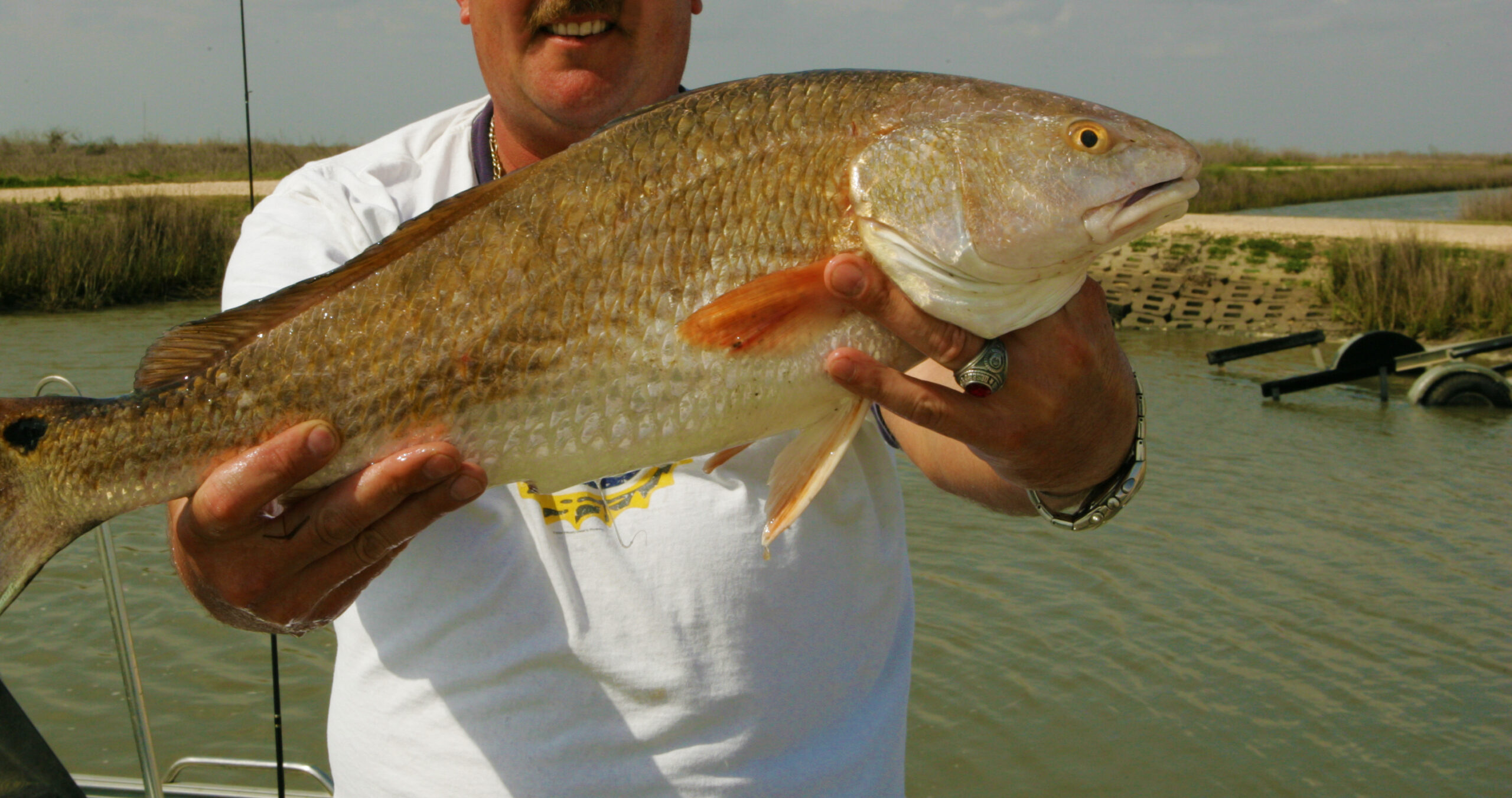
A new study shows that the act of tagging itself impacts growth rates — but that the effects could be temporary.
On November 13, the North Carolina Marine & Estuary Foundation unveiled a groundbreaking interactive tracking platform for red drum, North Carolina’s official state saltwater fish. The platform offers new insights into the movement patterns of tagged red drum.
But does tagging itself affect how much red drum move and grow?
Research Need
Red drum is vital to North Carolina’s coastal ecosystems as a key predator in the food web, as well as for the state’s commercial and recreational fisheries.
Fish tagging allows scientists and resource managers to track movements, migration, and behavior, thereby informing conservation measures. To ensure tagging doesn’t alter behavior, scientists use minimally intrusive tools, like acoustic transmitters (small, sound-emitting devices they surgically implant or attach with care).
They also follow the “2% Rule” for tagging, which states a fish should not carry a tag larger than 2% of its body weight. Due to this rule, and with micro-transmitters only now under development, there is a lack of research on smaller fish species, for which tagging is impossible.
In contrast, there is growing evidence that a tag weight limit of 3% to 10% may be more appropriate — which would significantly expand opportunities for research.
What did they study?
The Gulf Shores Mariculture Facility in the Marine Resources Division of the Alabama Department of Conservation & Natural Resources donated 43 juvenile red drum of large, intermediate, and small sizes to the Dauphin Island Sea Lab for a tank study.
The researchers at the Sea Lab subdivided each size of fish into three groups: (1) fish the research team surgically fitted with dummy (non-emitting) tags that were identical to functional transmitters at 1.4% to 5.6% of the fish’s body weight; (2) fish that received the same surgery but no tag; and (3) a control group that researchers handled similarly but without surgery.
The team monitored fish for growth, measuring them after 10 days and 24 days.
What did they find?
During the first 10 days, small and intermediately sized fish in the control group grew in length faster than fish in the other two groups. There was no evidence, however, of length differences in large fish across groups.
The percentage of tag weight to body weight had no effect on growth rates. In addition, by the end of the 24-day period, there was little to no evidence of a difference in growth among the fish in all size classes.
What else did they find?
Four fish (one control and three tagged) died within the first 10 days; however, this appeared to be due to factors outside of the study.
So what?
Reduced growth after 10 days indicates that tag weight and tagging surgery initially impact red drum feeding and physiology. It does appear that tagged fish then catch up to untagged fish. The researchers therefore recommend excluding data from the first 10 days after tagging when analyzing and drawing conclusions about the movement of red drum.
On a longer time scale, though, carrying a relatively heavier tag did not prevent red drum from feeding. Accordingly, it appears that the 2% Rule is too low for red drum, and that this species potentially can carry tags up to 5% of their body weight.
That said, more research is needed on the behavior and survival of red drum carrying tracking devices to understand impacts that growth observations alone cannot necessarily reveal.
Reading
Ramsden, S., Albins, M.A., & Baker, R. (2025). The importance of lab testing tracking tag burden: A case study using small, juvenile red drum, Fisheries Research, 292, 107580. https://doi.org/10.1016/j.fishres.2025.107580.
This research was funded by a Bullard Grant awarded to S. Ramsden from the University of South Alabama Stokes School of Marine & Environmental Sciences.
The text from Hook, Line & Science is available to reprint and republish at no cost, but only in its entirety and with this attribution: Hook, Line & Science, courtesy of Scott Baker and Sara Mirabilio, North Carolina Sea Grant.
- Categories:


