
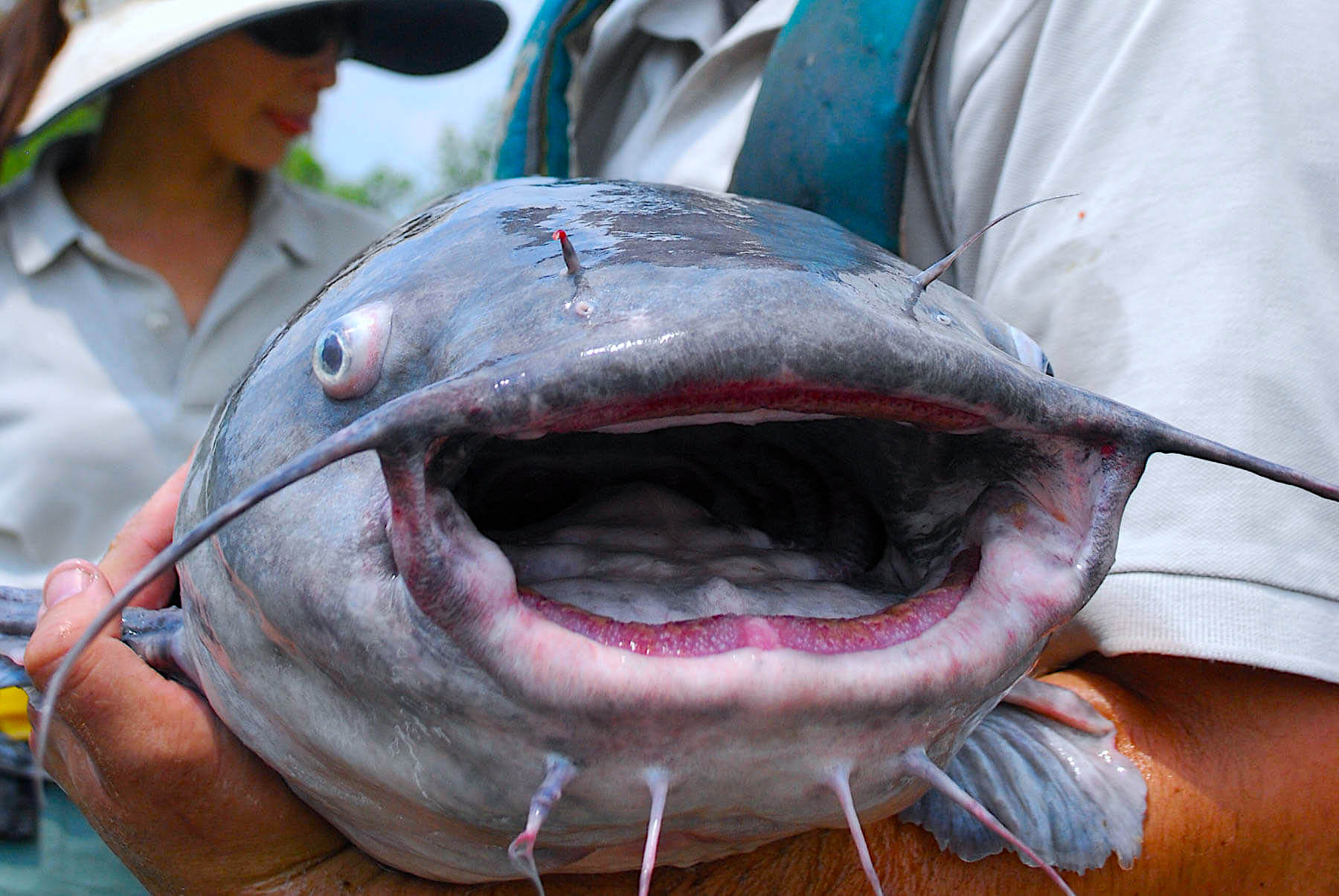
Blue catfish are spreading — and a new study sheds light on whether the species is competing with white catfish for prey.
Research Need
Blue catfish have rapidly expanded into estuaries along the U.S. Atlantic coast, where these ecosystems serve as important nursery habitats for many fish and invertebrates. While the diet of adult blue catfish has been studied, very little is known about what young catfish eat in these environments.
Are these relative newcomers eating the same things that species such as the white catfish eat?
Understanding the blue catfish’s feeding habits early in its life is key to figuring out how these fish might affect other species, because blue catfish could compete for the same food sources.
What Did They Study?
Researchers examined the diet of 422 juvenile blue catfish, ranging from about 1.2 to 9.0 inches long, over one year, from four tidal rivers within the Winyah Bay estuary in South Carolina. The team looked at stomach contents to identify types of prey and examined how diet varied by season, location, and fish size.
Their goal was to better understand feeding patterns during the early life stages of blue catfish and how those patterns change as these fish grow.
What Did They Find?
About 96% of the blue catfish were 5 inches long or shorter — a far cry from the largest blue catfish ever caught by rod and reel in South Carolina, a 113.8-pounder in 2017.
The young blue catfish had a broad diet, including a wide range of organisms such as insects, mollusks, worms, shrimp, crabs, and small fish.
Its most common prey were small crustaceans, especially amphipods, along with crustacean fragments and isopods. Many fish stomachs contained unidentifiable material.
What Else Did They Find?
Diet changed as the fish grew. Smaller catfish ate a wide variety of prey, while larger fish ate larger-bodied prey like crabs and mollusks.
So What?
Because juvenile blue catfish feed on many of the same bottom-dwelling organisms as species like white catfish, there is strong potential for competition in estuarine nursery habitats, which plays an important role in shaping food webs. (In fact, the population size of white catfish has been declining.)
This study provides key data that can inform evaluations of ecological impacts, as well as future monitoring and management of blue catfish in estuaries.
See also: “How Are Blue Catfish Infiltrating New Waters?”
Reading
Kimball, M. E., Clyburn, R. D., Batchelder, L. J., Pelton, M. M., & Dunn, R. P. (2026). Diet of juvenile invasive blue catfish (Ictalurus furcatus) in a southeastern US Atlantic coast estuary. Environmental Biology of Fishes, 109(2), 83. https://doi.org/10.1007/s10641-026-01853-5
Funding was provided by the Baruch Marine Field Laboratory, the USC Office of the Vice President for Research ASPIRE program (216000-21-56862), and the Lowcountry Shrimp Collaborative, which is part of the National Estuarine Research Reserve System Science Collaborative funded by the National Oceanic and Atmospheric Administration and managed by the University of Michigan Water Center (NA19NOS4190058).
The text from Hook, Line & Science is available to reprint and republish at no cost, but only in its entirety and with this attribution: Hook, Line & Science, courtesy of Scott Baker and Sara Mirabilio, North Carolina Sea Grant.

- Categories:


