Can citizen science offer a solution for data-poor situations in sport fish management?
Mapping local knowledge from anglers can reveal small-scale seasonal movements and more.
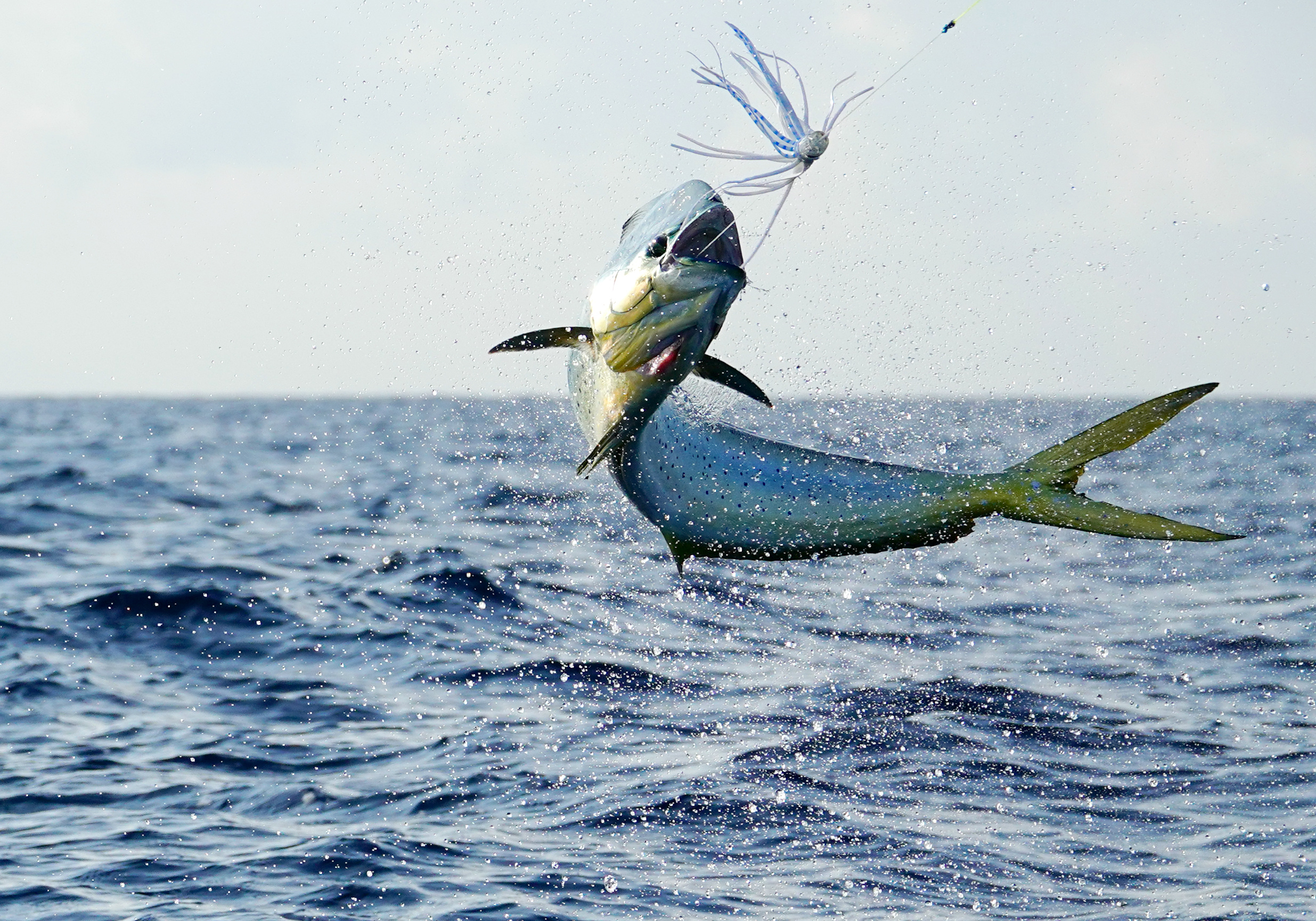
The first day of Spring is close at hand, and with it, fishing action on North Carolina charter boats for yellowfin tuna and mahi-mahi. But some anglers wonder, “Are trophy-sized mahi-mahi becoming harder to catch?”
Research Need
Recreational fishing in the South Atlantic region (the Carolinas, Georgia, and East Florida) is a multi-billion-dollar industry that supports tens of thousands of jobs. This means, however, recreational fishing has a significant and growing impact on fish populations in the region.
On average, recreational catches represent 76% of the total landings for many federally managed species. The for-hire sector (charter and head boats), specifically, yields roughly 900,000 angler trips annually.
For-hire passengers in the region often target mahi-mahi (also known as dolphinfish or dorado) and, to a lesser extent, wahoo. With increased fishing pressure, there is growing concern by both fishery managers and anglers regarding the population health of these species, which lack formal stock assessments or reliable measures of their populations.
What did they study?
Fishery managers in the South Atlantic conducted stakeholder workshops to uncover differences in angler preferences and fishing dynamics for the mahi-mahi and wahoo fishery.
Participants had heavy involvement in the fishery and hailed from two separate areas: South Florida and the Florida Keys (from Key West to Jupiter), and North Carolina and Virginia (from Bird Island, NC, to Wallops Island, VA). Incidentally, for the NC/VA region, fishery managers held gatherings in Beaufort and Wanchese NC, as well as in Virginia Beach.
The fishery managers then combined local knowledge with data from the NOAA Fisheries Marine Recreational Information Program and social media photos to characterize the for-hire fleet in the two subregions.
What did they find?
Even though mahi-mahi and wahoo are managed together, mahi-mahi emerged as a species of greater importance and concern. Anglers caught at least one mahi-mahi in 14% of their trips in North Carolina and Virginia, and 60% of their social media photos contained at least one mahi-mahi.
North Carolina and Virginia workshop participants indicated a seasonality to the fishery that matched closely with trends in social media and recreational monitoring programs. Participants emphasized the importance of “gaffer” mahi-mahi — mature fish weighing about 10 pounds or more — to their charter operations at the start of the season in April and May. Social media reflected peak catches of gaffers in May, as well as in June.
Recreational monitoring landings indicated gaffer-sized mahi-mahi in abundance from April to May, but followed by a dip in June and July, as well as a second peak in September followed by rapid decline.
In addition, “bailer” mahi-mahi (less than 5 pounds) became highly abundant starting in May, and increasing through September, then also declining steeply. There were no mahi-mahi landings from December to March.
However, workshop conversations also revealed that wahoo is important in the “shoulder seasons” (spring and fall), when other major target species are less available. Social media results likewise indicate a large peak in wahoo catches in October and a lesser peak in April.
Anything else?
There were significant differences between catches in Florida versus North Carolina and Virginia. In South Florida, catches are more diverse and less dominated by a small suite of species. However, mahi-mahi does tend to dominate catches year-round, and, with yellowtail snapper, contributes roughly one-third to one-half of all landings.
According to social media counts in South Florida, anglers caught gaffer mahi-mahi in small numbers throughout the year, with only slightly elevated landings from June to October. Bailer mahi-mahi were more abundant from May to June, followed by a gradual decrease through October.
Virginia Beach captains, in particular, noted mahi-mahi fishing effort is largely driven by tuna availability. This switch from tunas to mahi-mahi also is seen in the social media results.
Lastly, fishery managers found no measurable difference in landings in either subregion of the South Atlantic across years.
So what?
When it comes to fisheries management, subregional differences matter. In the case of mahi-mahi, there is seasonality in the availability of different size classes across the South Atlantic.
The study demonstrates how local knowledge could provide early warnings about shifts in a species’ range — or about other changes in a fishery. More generally, the study is also part of a new movement to incorporate the knowledge of local fishers increasingly into the processes of mapping and measuring fish populations.
Reading
Karnauskas, M, McPherson, M, Mastitski, A, Hadley, J, and Byrd, J. (2025) Characterization of the for-hire fishery in the U.S. South Atlantic and regional policy implications. Marine Policy. 182:106886. doi.org/10.1016/j.marpol.2025.106886
lead image: adobe stock.
The text from Hook, Line & Science is available to reprint and republish at no cost, but only in its entirety and with this attribution: Hook, Line & Science, courtesy of Scott Baker and Sara Mirabilio, North Carolina Sea Grant.
- Categories: