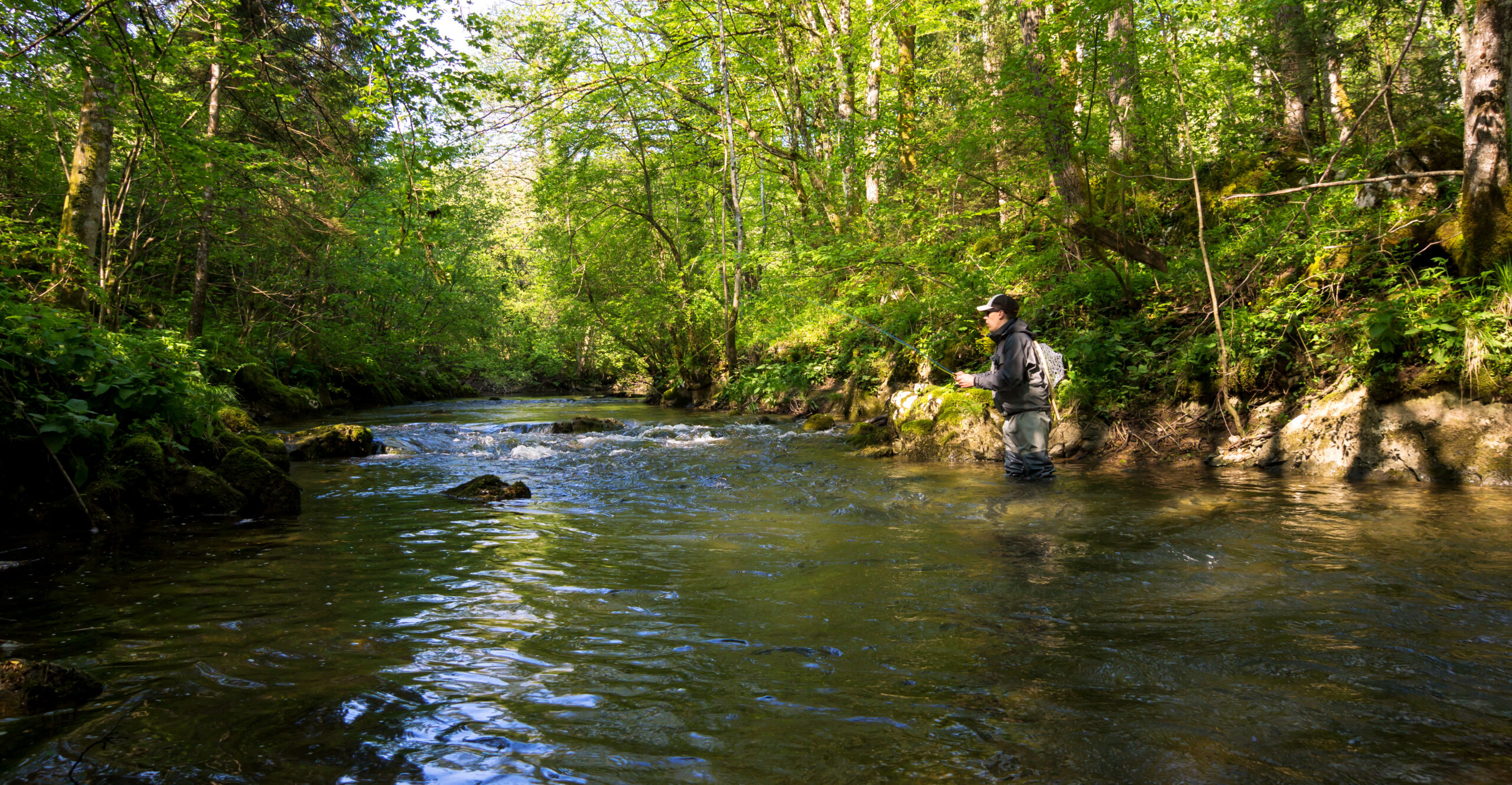
A 35-year-old record of temperatures and a new computer model inform where and when to stock in the future.
Research Need
The North Carolina Wildlife Resources Commission (NCWRC) manages approximately 5,200 miles of streams in North Carolina’s 26 westernmost counties. The most popular species include the native brook trout, the introduced brown trout, and rainbow trout. While most of these waters are managed such that fish replenish themselves naturally, about 900 miles of streams are managed through a combination of wild populations and stocking with hatchery-produced fish.
These managed stocked streams are important to anglers and the state’s economy. In 2022, about 370,000 anglers fished on these waters and generated a $1.38 billion impact on North Carolina’s economy.
But going forward, it could be difficult to keep all these anglers (and the fish) happy. That’s because North Carolina’s mountain trout are cold-water species and typically require temperatures that stay at or below 70 F.
How should we plan around future stocking efforts as stream temperatures continue to warm?
Luckily, a biologist way back in the early 1990s decided to start recording water temperatures during stocking events.
Could this record be the key to making a long-term stocking plan?
What did they study?
A research team focused on determining the future viability of the NCWRC’s spring-to-summer stocking season (which runs from March to July). Given that water temperatures above 70 F are widely considered unsuitable for stocking, the team used historical temperature data from 1992 to 2024 at 183 stream locations to forecast when and where future stocking events may not be feasible.
Researchers built a forecast model out to the year 2050, using water temperature data from over 25,000 stocking events.
What did they find?
Warming trends varied among streams, with a mean annual warming rate of 0.09 F. However, 50 streams currently being stocked are experiencing rapid warming trends of approximately 0.144 F per year.
This means it’s important to view specific results in terms of probabilities.
By 2050, there is a 90% chance that 7 of the 183 streams will have June or July water temperatures unsuitable for stocking using current protocols. There also is a 50% or greater chance that 107 of the 183 streams will have June-to-July water temperatures that are unsuitable by 2050.
So What?
While future water temperature trends are not encouraging, fishery managers do have options.
One approach is to abandon stocking altogether in select streams that are warming the fastest, and focus efforts in other areas, possibility stocking fish earlier in the year when temperatures are lower. Such a dynamic would be a change but would still allow angling opportunities, albeit at different times than in the past.
Interesting Facts
The State of North Carolina has supported trout fishing via stocking in North Carolina for over a century.
Over 1 million trout are produced annually at NCWRC hatcheries, where mean annual temperatures are approximately 52 F.
Ninety percent of stocking events are in March–July, but the stocking occurs March-November, except in September.
For each stocking, 96% are of trout that average 10.5-inches total length, and 4% are greater than 14-inches.
Reading
Xinyi Lu, Yoichiro Kanno, A. Powell Wheeler, and Jacob M. Rash. 2025. Stream temperature rise and future stocked- trout management in North Carolina. North American Journal of Fisheries Management, 45, 532–539. doi.org/10.1093/najfmt/vqaf052.
Funding: Federal Aid in Sport Fish Restoration Program (F- 108 Fisheries Investigations in North Carolina).
The text from Hook, Line & Science is available to reprint and republish at no cost, but only in its entirety and with this attribution: Hook, Line & Science, courtesy of Scott Baker and Sara Mirabilio, North Carolina Sea Grant.