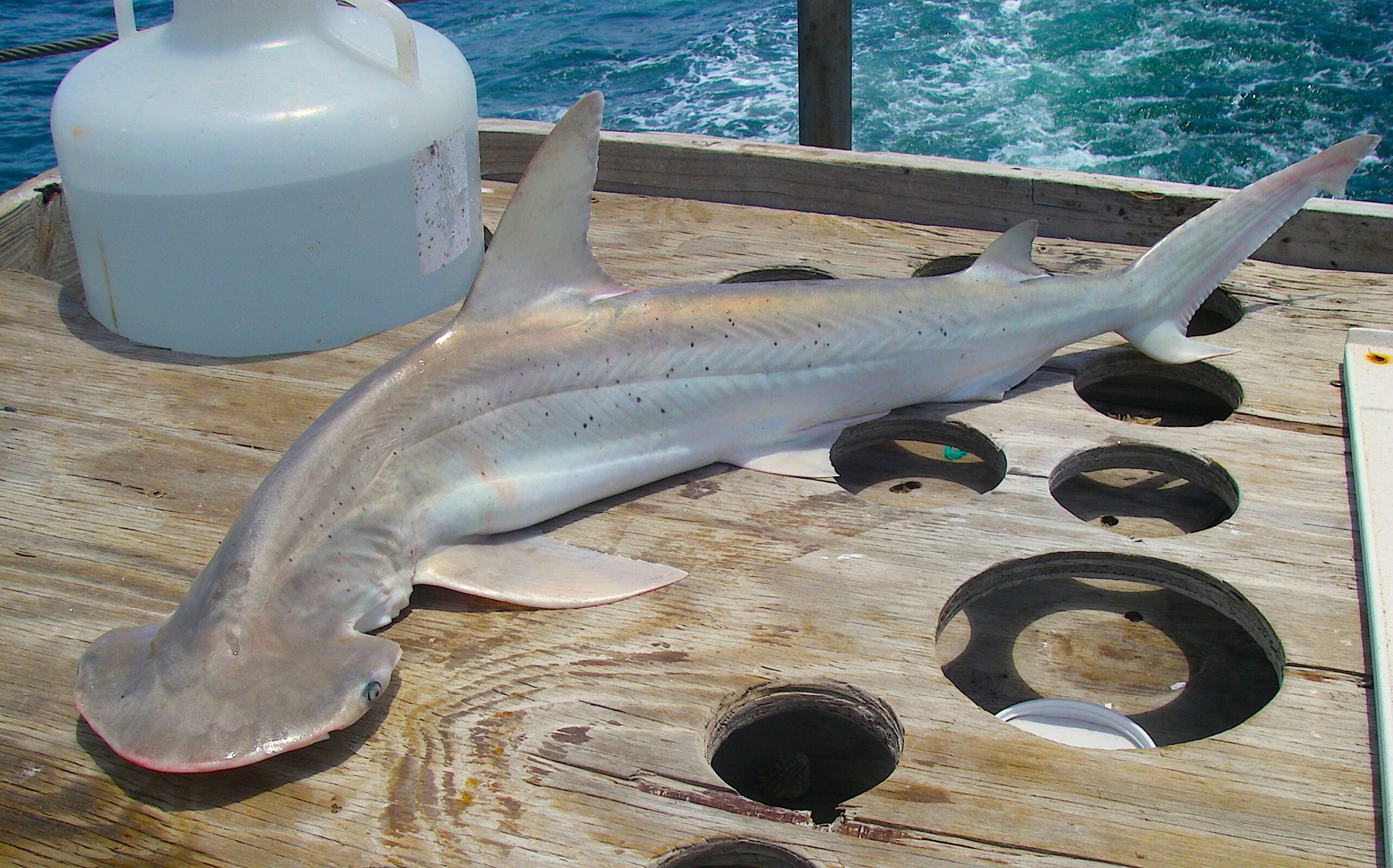
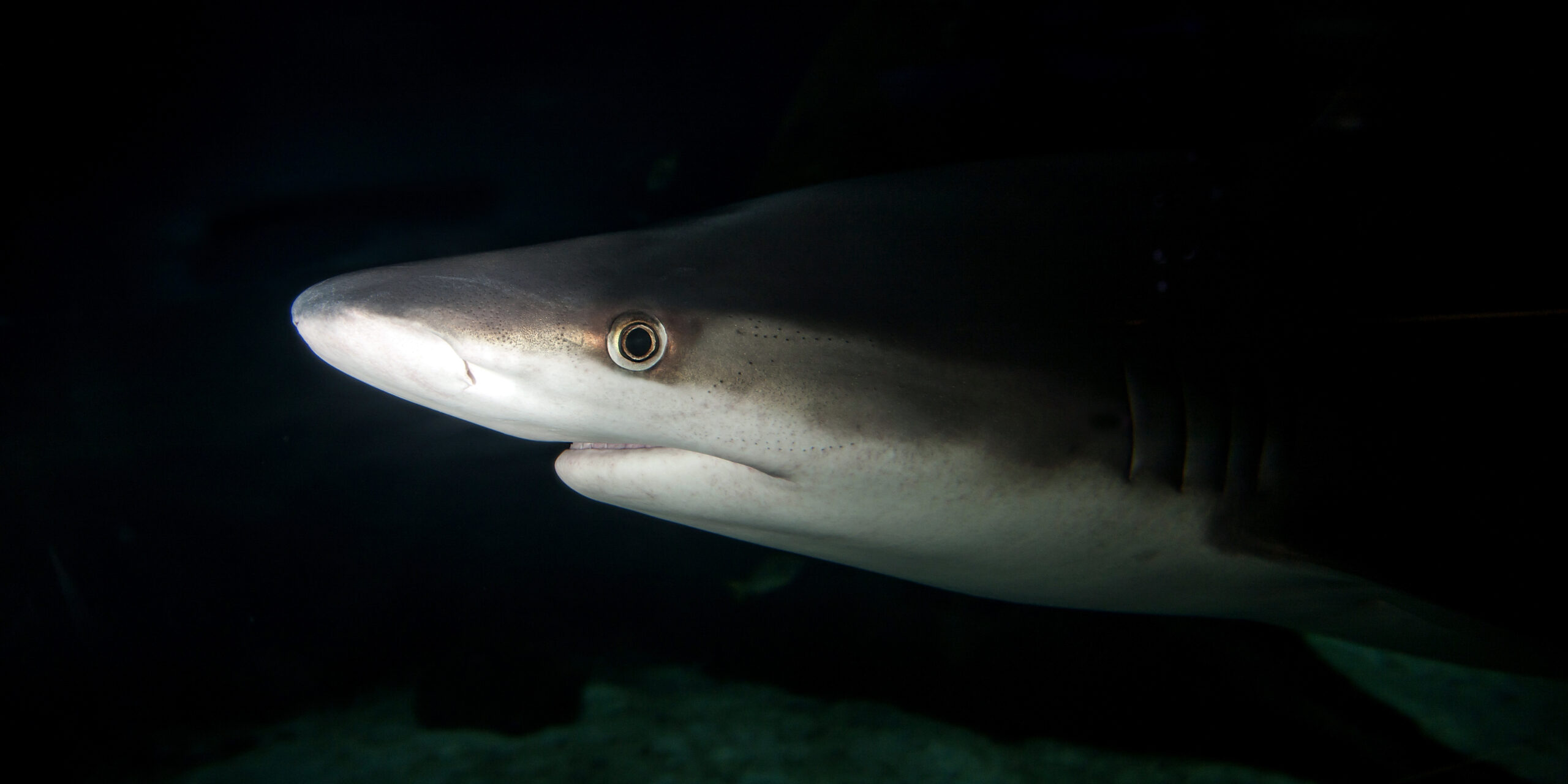
A new Community Collaborative Research Grant project relies on commercial fishers to investigate stolen catch.
Along the Atlantic coast, anglers and commercial fishers are reporting “shark depredation” — sharks stealing their catch right off the line.
“They’ll either pull up no fish, part of a fish, or even now a hooked shark, instead of their target catch, which can cause a lot of frustration,” says Chelsea Black, a shark scientist with the Georgia Aquarium and former postdoctoral fellow at the University of North Carolina at Chapel Hill. Black serves as the scientific co-lead with Joel Fodrie, director of the Duke Marine Lab, on a new project with North Carolina fishers to investigate shark depredation.
“Anecdotally, fishers have said that shark depredation is increasing across the state,” says Black. “But in North Carolina, we don’t have any baseline rates of depredation for comparison.” Black and Fodrie’s Community Collaborative Research Grant project is working to establish these baseline numbers and develop a procedure for documenting depredation events in the future.
Protected Predators
Despite their reputation as untouchable and deadly, shark populations are about half of what they were in the 1970s, according to Black and Fodrie. They say that while there need to be solutions that allow recreational and commercial fishers to end the day with their catches intact, these solutions must also align with the need to protect sharks.
Sharks are essential to smoothly running ocean ecosystems. They help curb populations of mid-level predators, such as mackerel and bluefish, by feeding on weak and sick fish.

By eating these fish, not only are healthier fish available for commercial and recreational fishing, but sharks help the populations of herbivores that mid-level fish typically consume. The herbivores graze on plants and algae that can overrun coral reefs and seagrass meadows, which provide a safe place for many species of juvenile fish to grow and develop.
Each link in this chain supports recreational and commercial fishing long term.
A Community Investigation
As frustrations about stolen catch understandably arise among fishers, it can be difficult to appreciate the benefit of non-retaliatory solutions. Black and Fodrie have chosen to approach the issue head-on by engaging local fishers.
“The goal of this initiative,” Black says, “is to better understand shark depredation within North Carolina’s fisheries and use that knowledge to develop practical, collaborative solutions that benefit both fishing communities and shark populations.”
For their investigation, Fodrie and Black have partnered with Anthony Procida, owner and captain for Grassy Sound Charters. Based in Surf City, Procida targets different fisheries, allowing his clients to catch a variety of fish, including tunas, snappers, mahi-mahi, wahoo, and king mackerel.

Procida says he has experienced shark depredation events involving all of these species.
“Sentiment, viewpoints, and opinions don’t properly inform or drive impact,” he says. For the project, he acted as “the conduit to charter and commercial fishermen in North Carolina that are experiencing shark interactions on nearly every trip. Together with Chelsea, we tried to recruit other participants or at least inform them that we are aware of shark depredation events along our coast, the overall impacts on their fishing effort, and that we were aiming to document these occurrences.”
Commercial fishers are already dealing with a large volume of attention-demanding tasks when out on the water, Black says. “Working closely with Anthony allowed us to design a project that was both scientifically sound and realistic to implement in both for-hire charter and commercial fisheries.”
Identifying the Perpetrators
Like investigators swabbing DNA at a crime scene, the researchers collected DNA from catches involved in shark depredation.
Each piece of DNA is composed of different building blocks, known as nucleotides, which appear in a unique order. By comparing the collected DNA to samples from identified shark species, the researchers determined which species of shark was involved in each event.

“I put together DNA kits for fishers that include swabs to collect samples from bite marks, as well as data sheets to record a depredation event,” explains Black. “The fishers were all trained to collect DNA from a bite mark, which is then stored in a preservative and sequenced back at the lab at UNC’s Institute of Marine Sciences.”
Another fisher involved in the study, Jack Graham, helped to connect the team to his own network of peers around the Oregon Inlet. The project was able to expand its reach, collecting samples from boats not originally included in the study.
Currently, Black is overseeing sample processing at the UNC Institute of Marine Sciences. While progress is still ongoing, the researchers have already identified Atlantic sharpnose sharks and sandbar sharks as two species that have been involved in depredation.
Both species are among the most common sharks in North Carolina waters. Atlantic sharpnose typically spend the warmer months in North Carolina’s sounds and estuaries, which provide cover for their young to grow. Fishers looking for puppy drum or Spanish mackerel often catch juvenile sharpnose accidentally.
Sandbar sharks spend their time farther from shore, and their numbers have severely declined from overfishing. However, their population has recovered somewhat because of their status as a prohibited species. Fishers must immediately return the species to the water with as few injuries as possible.

Black has also been able to verify that even if a fish has been on deck all day, the research team can still identify shark DNA from the swabs.
“This validation is important because it allows us to confidently interpret negative results,” Black explains. “If shark DNA is not detected from a bite wound, it is unlikely that a shark was involved in the depredation event, and the lack of DNA is not the result of human error or delayed sampling.”
The fishers also recorded shark sightings, which means researchers can verify whether the sharks spotted were involved in an associated depredation event. “The fishers often assume the shark they saw was guilty,” says Black, “when another species of shark or a large fish could have stolen the catch.”
While there is still much to learn about shark depredation in North Carolina waters, the project has already shown the value of collaborative initiatives between scientists and commercial fishers.
“Even when perspectives differed,” says Black, “our shared passion for the ocean and marine life made conversations easier and more productive. It changed the project from simply a research study conducted within the fishing community into a true partnership.”
More from Coastwatch on sharks
“Sustainable Fisheries: Keeping Sharks Off Gear”
More from Coastwatch on sustainable fisheries and aquaculture
North Carolina Sea Grant and the NC Water Resources Research Institute, in partnership with the William R. Kenan Jr. Institute for Engineering, Technology and Science (KIETS), support the Community Collaborative Research Grant Program.
Lily Soetebier is a contributing editor for Coastwatch and an award-winning science communicator at North Carolina Sea Grant. She holds an M.S. in technical communication from North Carolina State University.
- Categories: