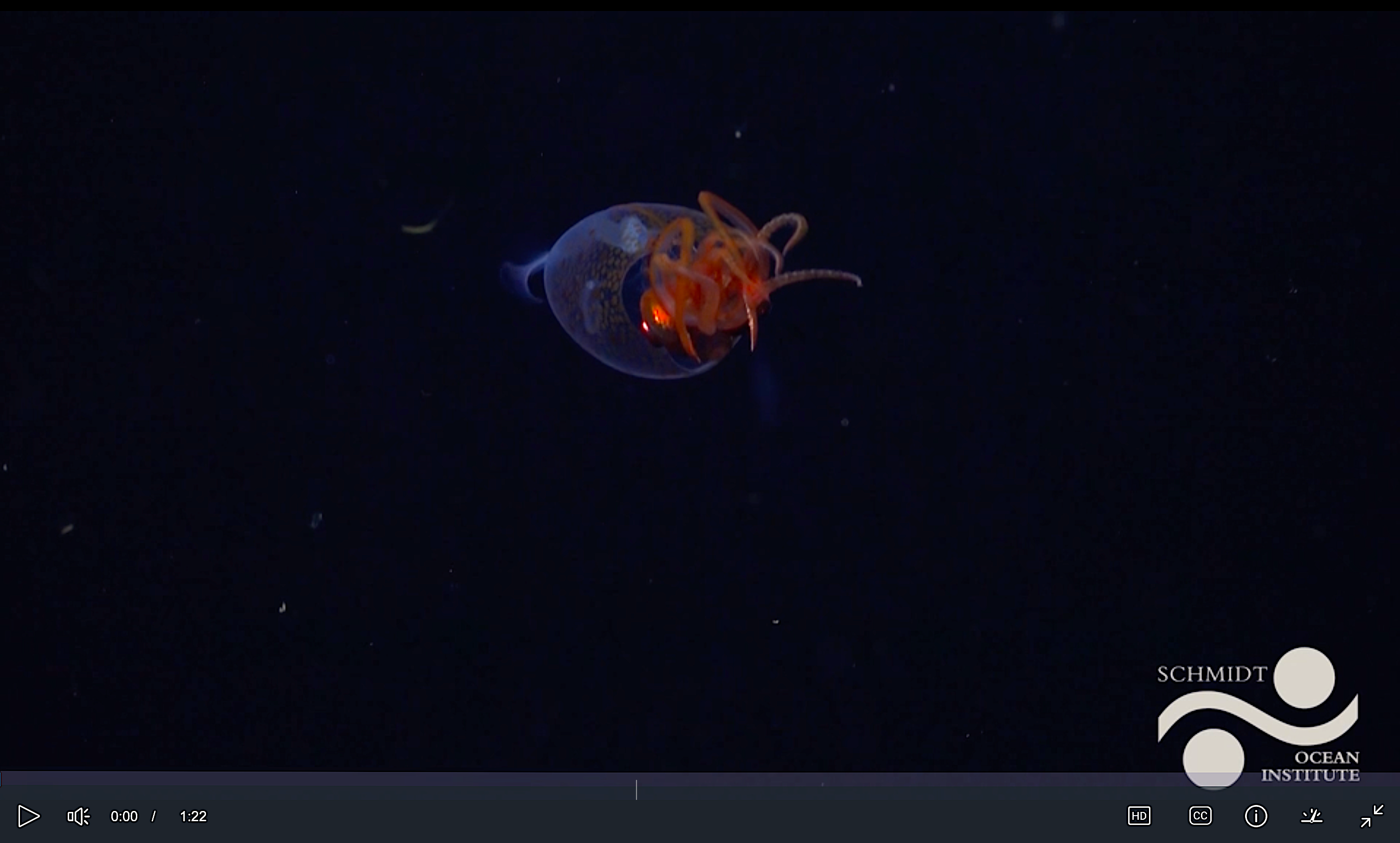
VIDEO: First Sighting of a Colossal Squid in its Natural Habitat
And It’s a Baby

One hundred years after the colossal squid’s discovery, a team on board a Schmidt Ocean Institute research vessel has filmed the species in waters off the South Sandwich Islands.
An international team of scientists and crew on board a Schmidt Ocean Institute’s research vessel in 2025 was the first to film the colossal squid (Mesonychoteuthis hamiltoni) in its natural environment. The 30-centimeter juvenile squid (nearly one foot long) was captured on video at a depth of 1,968 feet by the Institute’s remotely operated vehicle (ROV) SuBastian. Last year was the 100-year anniversary of the identification and formal naming of the colossal squid, a member of the glass squid family (Cranchiidae).
The sighting occurred on on an expedition near the South Sandwich Islands in the South Atlantic Ocean. Watch the footage here.
The 35-day expedition that captured the footage of the colossal squid was an Ocean Census flagship expedition searching for new marine life – a collaboration between Schmidt Ocean Institute, the Nippon Foundation-Nekton Ocean Census, and GoSouth, a joint project between the University of Plymouth (UK), GEOMAR Helmholtz Centre for Ocean Research (Germany), and the British Antarctic Survey.
“It’s exciting to see the first in situ footage of a juvenile colossal and humbling to think that they have no idea that humans exist,” said Kat Bolstad of the Auckland University of Technology, one of the independent scientific experts the team consulted to verify the footage. “For 100 years, we have mainly encountered them as prey remains in whale and seabird stomachs and as predators of harvested toothfish.”
Colossal squid are estimated to grow up to 23 feet in length and can weigh as much as 1,100 lbs, making them the heaviest invertebrate on the planet. Little is known about the colossal squid’s life cycle, but eventually, they lose the see-through appearance of the juveniles. Dying adults have previously been filmed by fishers, but have never been seen alive at depth.
Aaron Evans, another independent expert on the glass squid family, also confirmed the footage. Bolstad and Evans said one of the most distinguishing characteristics of colossal squid is the presence of hooks on the middle of their eight arms, which help differentiate them.
In addition, the first confirmed footage of the glacial glass squid, Galiteuthis glacialis, was filmed in the Bellingshausen Sea near Antarctica during the Schmidt Ocean Institute’s January 2025 expedition, which examined the seafloor after an iceberg the size of Chicago calved from the George VI ice shelf.

“The first sighting of two different squids on back-to-back expeditions is remarkable and shows how little we have seen of the magnificent inhabitants of the Southern Ocean,” said Schmidt Ocean Institute’s executive director, Jyotika Virmani. “Fortunately, we caught enough high-resolution imagery of these creatures to allow the global experts, who were not on the vessel, to identify both species.”
The Schmidt Ocean Institute’s ROV SuBastian also has captured the first confirmed footage of other squid species in the wild, including the Spirula spirula (Ram’s Horn Squid) in 2020 and the Promachoteuthis in 2024.
“These unforgettable moments continue to remind us that the ocean is brimming with mysteries yet to be solved,” Virmani said.
See also: Who Wants to See a 30-Foot Jellyfish?
Published with the permission of Schmidt Ocean Institute. Eric and Wendy Schmidt established Schmidt Ocean Institute in 2009 “to catalyze the discoveries needed to understand our ocean, sustain life, and ensure the health of our planet through the pursuit of impactful scientific research and intelligent observation, technological advancement, open sharing of information, and public engagement, all at the highest levels of international excellence.”


